Introduction
A 4D 16-line green laser level is a useful layout tool for construction, renovation, and installation projects that require accurate horizontal and vertical reference lines. Depending on the model, it can project multiple laser planes around a room, helping tradespeople align tiles, cabinets, wall fittings, ceilings, and other building components.
These tools are available in different designs and price ranges. Their accuracy, working range, battery life, durability, and included accessories can vary considerably. Understanding the main features can help you choose a laser level that suits your work without paying for functions you may not need.
What Is a 4D 16-Line Green Laser Level?
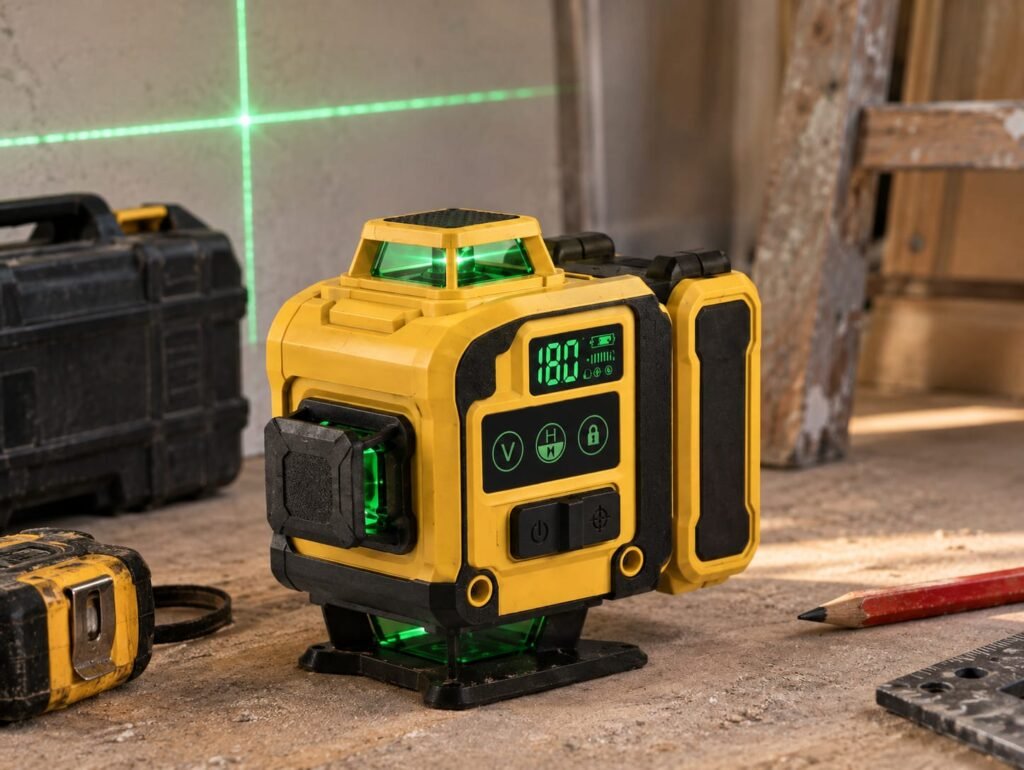
A 4D 16-line green laser level is designed to project multiple horizontal and vertical laser lines across floors, walls, and ceilings. Many models use four 360-degree laser planes, although the exact arrangement depends on the product.
The projected lines provide visual reference points that can help users maintain consistent alignment during installation work. Green laser lines may be easier to see than red lines in some indoor conditions, but visibility depends on the laser specifications, surrounding light, distance, and surface.
The term “4D 16-line” does not guarantee the same performance or specifications across every model. Buyers should compare the documented features of individual products before making a decision.
Key Technical Features and Capabilities
Multiple 360-Degree Laser Planes
Many 4D laser levels are designed to provide horizontal and vertical coverage around a room. This can be convenient when working on several walls or surfaces because the tool may not need to be repositioned as frequently.
Before buying, check the number and arrangement of the laser planes. Product descriptions can use similar terminology while offering different configurations.
High-Visibility Green Laser
Green laser lines can be useful for indoor layout tasks such as tile installation, cabinet positioning, and setting reference heights. However, strong daylight can make laser lines difficult to see, particularly outdoors.
If you regularly work outside, check whether the selected model supports a compatible laser receiver. Not every laser level works with one.
Self-Leveling System
Many laser levels include a self-leveling mechanism that helps establish a level reference when the tool is positioned within its specified operating range.
The permitted leveling angle and warning system vary by model. Always check the manufacturer’s instructions to understand when the tool is properly leveled.
Some models also include a manual mode for projecting angled lines. This can help with certain staircase, railing, or decorative installation projects.
Display, Remote Control, and Adjustments
Depending on the model, a laser level may include a digital display, remote control, or controls that allow users to switch individual laser planes on and off.
These features can make operation more convenient, but they are not standard on every product. Check the manufacturer’s specifications and package contents rather than assuming a particular model includes them.
Mounting Options and Accessories
Depending on the package, a laser level may include a magnetic bracket, tripod mount, wall bracket, carrying case, remote control, or rechargeable battery.
These accessories can make setup and operation easier, but they are not included with every model. Check the product listing carefully before purchasing.
Practical Applications Across Different Trades
Tile Installation
A laser level can help tile installers establish horizontal and vertical reference lines before placing tiles. These references can make it easier to plan a layout, maintain consistent rows, and identify alignment issues.
The tool does not replace careful measurements, appropriate surface preparation, or proper installation techniques.
Electrical Installation
Electricians can use laser reference lines to help position socket outlets, switches, cable routes, and other fittings at consistent heights across a room.
For drilling and fastening tasks associated with electrical installation, see our related guide:
. How to Choose the Best Cordless Drill for Concrete and Walls
Always check for concealed electrical cables and pipes before drilling into walls, and follow the appropriate electrical safety procedures.
Drywall and Ceiling Work
Laser levels can assist with aligning drywall framing, suspended ceiling grids, and other components that require consistent horizontal or vertical positioning.
The tool’s usefulness depends on the room layout, mounting method, and visibility of the laser lines.
Cabinet and Furniture Installation
When installing kitchen cabinets, shelves, or wall-mounted furniture, a laser reference can help maintain a consistent line across a wall.
Users should still verify measurements, mounting points, wall conditions, and load requirements before drilling or fastening components.
General Assembly and Workshop Projects
A laser level can also help with positioning fixtures, arranging wall-mounted storage, and aligning components during renovation or workshop projects.
For fastening tasks, a cordless screwdriver may be a useful complementary tool. Read our related guide:
.Best Professional Cordless Screwdriver Review: Features, Uses and Buying Guide
Advantages of a 4D 16-Line Green Laser Level
A 4D laser level can offer several practical advantages, depending on the model and the work involved.
- Wide layout coverage: Multiple laser planes can provide reference lines across several surfaces.
- Convenient alignment: Visible lines can make it easier to establish consistent horizontal and vertical references.
- Versatile applications: Suitable models can be useful for tiling, cabinetry, electrical fitting, drywall, and general renovation.
- Potential time savings: A correctly positioned laser can reduce repeated manual marking for some layout tasks.
- Useful indoor visibility: Green lines can be easier to see in certain indoor conditions.
- Flexible setup: Compatible mounting accessories can help position the tool for different projects.
These benefits depend on choosing an appropriate model and using it correctly.
Limitations to Consider
Although laser levels can simplify layout work, they have limitations.
- Outdoor visibility: Strong sunlight can make the projected lines difficult to see.
- Different specifications: Accuracy, working range, battery runtime, and protection ratings vary between models.
- Setup requirements: The tool must be placed securely and operated according to its instructions.
- Measurement is still necessary: Important dimensions and reference points should be checked independently.
- Battery and accessory costs: Replacement batteries, mounting brackets, or receivers may add to the overall cost.
- Model compatibility: Some accessories and receivers only work with specific laser levels.
A laser level should be treated as a layout aid rather than a replacement for professional measurement and installation practices.
What to Check Before Buying
Before choosing a 4D 16-line green laser level, compare the documented specifications and package contents instead of relying only on the product title or promotional images.
Accuracy
Check the manufacturer’s stated accuracy and the conditions under which it is measured. Accuracy is particularly important for tasks where small alignment errors can accumulate over long distances.
Working Range
Choose a working range suitable for the size of your usual projects. Keep in mind that the practical visibility of the laser may be lower in bright environments.
Self-Leveling Range
Review the permitted self-leveling angle and the warning system. Follow the instructions for positioning the tool and checking whether it is level.
Battery System and Runtime
Check the battery type, charging method, whether batteries are included, and the manufacturer’s stated runtime. Do not assume every model provides the same operating time.
Durability and Protection
If the tool will be used on construction sites, check whether the manufacturer specifies dust or water protection. Do not assume a product has an IP54 rating or another protection level unless it is documented for that model.
Mounting Compatibility
Confirm whether the package includes the tripod, magnetic bracket, wall mount, or other accessories you need. Some accessories may have to be purchased separately.
Warranty and Customer Support
Consider warranty terms, customer support, the availability of replacement batteries, and the ease of obtaining compatible accessories. Clear instructions and reliable after-sales support can be important when choosing a tool for regular professional use.
Tips for Using a Laser Level Effectively
- Place the tool on a stable surface or secure it with a compatible mount.
- Position it where the laser lines can reach the surfaces you need to align.
- If the model has self-leveling, allow the mechanism to settle and check any warning indicators.
- Follow the manual when selecting the laser planes or changing operating modes.
- Mark reference points carefully and verify important dimensions independently.
- Protect the tool from impacts, dust, moisture, and unsuitable storage conditions.
- Check its accuracy according to the manufacturer’s recommended procedure, particularly if it has been dropped or damaged.
- Use a compatible receiver when necessary and supported by the model, especially for work where the laser lines are difficult to see.
Never look directly into a laser beam or point it toward another person’s eyes. Follow the manufacturer’s laser-safety instructions.
Is a 4D 16-Line Green Laser Level Worth Buying?
A 4D laser level may be a useful investment for people who regularly carry out layout work across several walls, floors, or ceilings. Tradespeople who install tiles, cabinets, drywall, or electrical fittings may benefit from the additional reference lines offered by suitable models.
For occasional home projects, a simpler laser level may be sufficient. The right choice depends on the type of work, the required accuracy, the working environment, and the available budget.
Rather than choosing a product based only on the number of laser lines, compare its documented accuracy, visibility, battery system, mounting options, warranty, and customer support.
Final Thoughts
A 4D 16-line green laser level can be a practical addition to a construction or renovation toolkit. Depending on its features, it may help with tile installation, electrical fitting, drywall, cabinetry, and other projects that require consistent horizontal and vertical alignment.
However, the label “4D 16-line” does not guarantee a particular accuracy level, battery runtime, protection rating, or set of accessories. Compare the specifications of individual models and choose one that matches your working conditions and budget.
With appropriate setup and careful measurement, a suitable laser level can make many layout tasks easier and more consistent.