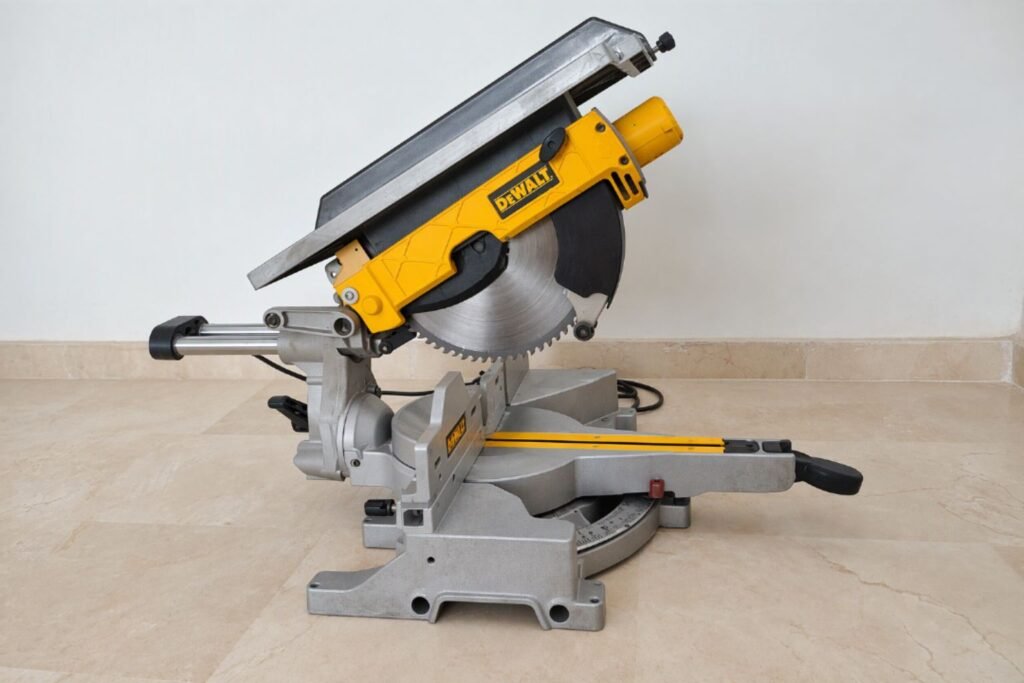
The DeWalt D27111 Combination Saw is a versatile woodworking machine designed to perform two important cutting operations in one unit. It works as a mitre saw for crosscuts and angled cuts, and it can also be configured as a table saw for ripping timber along its length.
The DeWalt D27111 Combination Saw is designed for workshops that need the flexibility of two cutting functions in one machine. It combines a mitre saw for angled and crosscuts with a table saw for working with wider boards and longer materials.
The D27111 belongs to DeWalt’s professional woodworking range. It features a 1,500 W induction motor, a 305 mm blade, and a sliding cutting mechanism designed to increase crosscut capacity.
In this guide, we look at its main features, applications, advantages, limitations, related DeWalt models, and seven practical tips to consider when using or buying a combination saw.
What Is the DeWalt D27111 Combination Saw?
The DeWalt D27111 is a combination mitre and table saw. Its main advantage is that it brings two different cutting functions together in one machine.
In mitre saw mode, the machine is used for crosscutting timber, making mitre cuts, and producing angled cuts. This is useful when preparing wood for frames, trim, flooring, and other woodworking projects.
In table saw mode, the machine is configured for ripping, which means cutting timber lengthwise. The upper table and parallel fence help guide the material through the blade.
This dual-purpose design can be useful for professionals and experienced DIY users who need both types of cutting without installing two separate machines.
DeWalt D27111: Main Features and Specifications
The D27111 combines a robust motor with a cast-aluminium base and a practical sliding cutting system.
Technical Specifications
| Specification | DeWalt D27111 |
|---|---|
| Machine type | Combination mitre and table saw |
| Voltage | 230 V |
| Motor power input | 1,500 W |
| Motor power output | 1,100 W |
| Motor type | Induction motor |
| Maximum blade speed | 2,950 rpm |
| Blade diameter | 305 mm |
| Blade bore | 30 mm |
| Blade body thickness | 1.8 mm |
| Riving knife thickness | 2 mm |
| Maximum mitre capacity | 50° left / 60° right |
| Maximum bevel capacity | 48° left / 0° right |
| Crosscut capacity at 90°/90° | 220 × 90 mm |
| Cutting width at 45° mitre | 155 mm (at 90 mm height) |
| Cutting width at 45° bevel | 220 mm (at 50 mm height) |
| Maximum table-saw cutting depth | 51 mm |
| Automatic blade stopping time | Less than 10 seconds |
| Weight | 26.5 kg |
Specifications can vary slightly between regional versions and product documentation. Always check the rating plate and the instruction manual supplied with the individual machine.
1. 1,500 W Induction Motor
The D27111 uses a 1,500 W induction motor designed for demanding woodworking applications.
An induction motor is generally appreciated for its relatively quiet operation and low routine maintenance requirements compared with many brushed motor designs.
This motor provides the power needed for normal crosscutting and ripping applications within the machine’s specified cutting capacity. However, the correct blade and a suitable feed rate remain important, especially when working with hardwood.
2. 305 mm Saw Blade
The machine uses a 305 mm circular saw blade with a 30 mm bore.
The blade size gives the D27111 useful cutting capacity for a range of timber sections. The correct blade should always be selected according to the material and the type of cut.
A blade designed for clean crosscutting may have different tooth geometry from one intended for ripping. Using the appropriate blade helps achieve better results and reduces unnecessary strain on the machine.
3. Two Cutting Modes in One Machine
One of the most useful features of the D27111 is its combination design.
Mitre saw mode: The machine is used for crosscuts, mitre cuts, and bevel cuts. It is suitable for preparing timber components that need accurate angles.
Table saw mode: The machine is converted to use its upper table for longitudinal cutting. The parallel fence helps guide the timber during ripping operations.
This arrangement gives the user more flexibility without requiring two separate machines.
4. Sliding Cutting Mechanism
The D27111 includes a sliding mechanism that increases its crosscutting capacity.
This is particularly useful when cutting wider timber pieces that would be difficult to handle with a fixed-head mitre saw of similar size.
The sliding mechanism should move smoothly and remain properly adjusted. Dust, damaged components, or poor maintenance can affect movement and cutting accuracy.
5. Cast-Aluminium Base and Table
The machine features a precision-machined aluminium base and upper table.
These components provide a stable working platform while helping keep the machine relatively portable for a combination saw.
The parallel fence and adjustable cutting guides also help the operator position timber accurately for different jobs.
Common Uses of the DeWalt D27111
The D27111 can handle several common woodworking tasks.
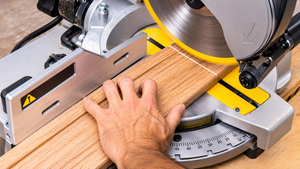
- Crosscutting timber: Cutting boards and wooden sections to the required length.
- Mitre cutting: Preparing angled joints for frames, trim, and mouldings.
- Bevel cutting: Producing angled edges when the job requires them.
- Compound mitre cutting: Combining mitre and bevel angles within the machine’s permitted settings.
- Ripping timber: Cutting boards lengthwise in table saw mode.
- Workshop preparation: Preparing wooden components for furniture, installation, and general carpentry work.
The machine is designed for woodworking applications. It should not be used to cut materials that are outside the manufacturer’s approved applications.
Advantages of the DeWalt D27111
One of the main advantages of the DeWalt D27111 Combination Saw is its dual-purpose design. It allows users to perform both mitre saw and table saw operations with one machine, helping save valuable workshop space.
Other advantages include:
- A 1,500 W induction motor.
- A 305 mm blade for useful cutting capacity.
- A sliding mechanism for wider crosscuts.
- Mitre and bevel adjustment options.
- An aluminium base and upper table.
- A combination design that reduces the need for two separate machines.
For a workshop that regularly needs both crosscutting and ripping, this arrangement can be practical.
Limitations to Consider
A combination saw is not automatically the best choice for every workshop.
The D27111 has a maximum table-saw cutting depth of 51 mm. Users who regularly need to rip thicker timber may require a dedicated table saw with greater capacity.
It also requires the operator to understand how to configure the machine correctly for each cutting mode. Changing modes takes more preparation than simply moving between two separate machines.
The machine’s 26.5 kg weight is manageable for a combination saw, but it is not as convenient to carry as a small portable circular saw.
Finally, the condition of an older machine matters. The motor, blade, guards, adjustment mechanisms, electrical components, and sliding parts should all be checked before use.
7 Practical Tips for Using or Buying a DeWalt D27111
1. Check the Overall Condition
If you are considering a used D27111, inspect the complete machine before buying.
Check the base, upper table, sliding mechanism, fences, adjustment controls, blade guard, and electrical components. Look for cracks, missing parts, excessive play, or signs of previous repairs.
Do not judge a used machine by its external appearance alone.
2. Inspect the Blade
The blade has a direct effect on cutting quality and operating safety.
Check that it is suitable for the material, has the correct diameter and bore, and is free from cracks, missing teeth, or excessive wear.
Always disconnect the machine from the power supply before inspecting or changing the blade.
3. Check the Mitre and Bevel Adjustments
Accurate angle settings are important for frames, trim, and other woodworking joints.
Check the mitre scale, bevel adjustment, locking mechanisms, and fences. If possible, verify the cutting accuracy with a suitable square and a test piece of timber.
Do not assume that the scale is accurate simply because the pointer is aligned with a mark.
4. Understand Both Cutting Modes
Before operating the machine, make sure you understand how to configure it for mitre saw mode and table saw mode.
Follow the manufacturer’s conversion procedure and confirm that all required guards, fences, and locking components are correctly installed.
Never attempt to change the machine’s configuration while it is connected to the power supply.
5. Use the Correct Blade for the Job
Different woodworking operations require different blade designs.
Choose a suitable blade for crosscutting or ripping, while following the manufacturer’s requirements for blade diameter, bore, speed rating, and compatibility.
A suitable blade can improve the finish and reduce unnecessary strain on the motor.
6. Check the Electrical Components
On an older used machine, inspect the power cable, plug, switch, and other electrical components.
If the machine has been repaired or modified, make sure the replacement parts are suitable and correctly installed by a qualified person.
A modified electrical switch should not be assumed to be equivalent to the original factory component. If its suitability or safety is uncertain, have the machine inspected before using it.
7. Maintain the Machine Regularly
Wood dust and debris can affect the movement and adjustment of a woodworking machine.
Keep the table, sliding mechanism, fences, and accessible components clean. Check the guards and locking mechanisms regularly, and follow the maintenance instructions in the manual.
Good maintenance helps preserve cutting accuracy and supports safer operation.
DeWalt D27111 vs Other DeWalt Combination Saw Models
The D27111 is part of a wider family of DeWalt combination saws. Several related models offer different motor power, blade sizes, cutting arrangements, and additional features.
DeWalt D27112-QS
The D27112 is a closely related 305 mm combination saw. It has a 1,600 W motor and offers a different specification from the D27111.
It is worth comparing these two models when looking at older DeWalt combination saws, especially if cutting capacity and motor specifications are important.
DeWalt D27113-QS
The D27113 is another 305 mm combination saw in the same general product family.
One of its notable features is the XPS cut-line indication system, which uses a shadow to help show the blade’s cutting line on the workpiece.
This can help with positioning timber before making a cut.
DeWalt DW743N
The DW743N is a 250 mm combination saw with a 2,000 W motor.
Unlike the D27111’s sliding combination design, the DW743N belongs to DeWalt’s flip-over combination saw family. It changes between mitre saw and table saw configurations using a different conversion arrangement.
DeWalt D27107 and D27107XPS
The D27107 is a 305 mm combination saw with a 2,000 W motor and a flip-over design.
The D27107XPS is a related version that includes the XPS cut-line indication system.
These models are worth considering when comparing different types of DeWalt combination saws, but their design and operating procedures are not identical to those of the D27111.
Modern DeWalt Alternatives to Consider
The D27111 combines two cutting functions in one machine. However, some users may prefer to buy a separate mitre saw and table saw.
Here are several DeWalt models that cover similar individual woodworking tasks.
DeWalt DWS780 Sliding Compound Mitre Saw
The DWS780 is a sliding compound mitre saw designed for crosscutting and angled cutting applications.
It is a separate mitre saw rather than a combination table and mitre saw. It may suit users who prioritise crosscutting capacity and mitre work.
DeWalt DWS727 Sliding Compound Mitre Saw
The DWS727 is another sliding compound mitre saw. It is designed for accurate crosscuts, mitre cuts, and bevel applications.
It is an alternative to consider when the main requirement is mitre saw performance rather than table saw functionality.
DeWalt DWE7492 Table Saw
The DWE7492 is a dedicated table saw designed for ripping and other table-saw operations.
It provides a different working arrangement from the D27111 and may suit workshops that frequently cut longer or wider boards.
DeWalt DWE7485 Compact Table Saw
The DWE7485 is a more compact table saw option.
It is worth considering for users who need a dedicated table saw but have limited workshop space.
Important: These modern models do not reproduce the exact two-in-one arrangement of the D27111. The DWS780 and DWS727 are mitre saws, while the DWE7492 and DWE7485 are table saws. A user who wants both functions may need to consider two separate machines.
Safety Tips When Using a Combination Saw
A combination saw has an exposed cutting blade and can cause serious injuries if used incorrectly.
Always follow the manufacturer’s instruction manual and use the machine only in the approved configuration.
Important safety precautions include:
- Wear suitable eye and hearing protection.
- Keep hands away from the cutting path.
- Use the correct blade guard and other supplied safety components.
- Secure the workpiece properly before cutting.
- Use a push stick when required for table saw operations.
- Never remove or disable safety guards to make a cut easier.
- Disconnect the power before changing the blade, adjusting the machine, or carrying out maintenance.
- Keep the working area clean and free from loose offcuts.
- Do not operate the machine if the switch, cable, guards, or other safety components are damaged or unsuitable.
For additional woodworking machinery safety guidance, consult the UK Health and Safety Executive (HSE):
HSE – Working with Woodcutting Machinery
Frequently Asked Questions
Is the DeWalt D27111 a mitre saw or a table saw?
It is both. The D27111 is a combination saw that can be configured as a mitre saw for crosscutting and angled cuts, or as a table saw for ripping timber.
What size blade does the DeWalt D27111 use?
The D27111 uses a 305 mm circular saw blade with a 30 mm bore. Always check the machine’s manual and the blade specifications before fitting a replacement.
What is the motor power of the D27111?
The D27111 has a rated power input of 1,500 W and uses an induction motor.
Can the D27111 cut wide timber?
Yes. Its sliding mechanism increases crosscut capacity. The published crosscut capacity at 90°/90° is 220 × 90 mm, subject to the correct setup and material support.
Is the DeWalt D27111 suitable for professional use?
The D27111 was designed for professional woodworking applications. Its practical value today depends on the condition of the individual machine, the type of work, and the availability of suitable replacement parts.
What is the difference between the D27111 and DW743N?
Both are DeWalt combination saws, but they use different designs. The D27111 has a 305 mm blade and a sliding cutting mechanism, while the DW743N is a 250 mm flip-over combination saw with a different conversion system.
Related Articles
Bosch GOF 2000 CE Review: Features, Uses & 7 Practical Tips.
Bosch Professional Jigsaw: Features, Uses and Safety Guide.
Final Thoughts
The DeWalt D27111 Combination Saw is an interesting example of a machine designed to make a woodworking workshop more flexible. By combining mitre saw and table saw functions, it can handle a range of common cutting operations without requiring two separate machines.
Its 1,500 W induction motor, 305 mm blade, sliding mechanism, and adjustable cutting angles make it a practical machine for suitable woodworking applications.
However, buyers considering a used D27111 should pay close attention to its condition, electrical components, guards, and adjustment mechanisms. A well-maintained machine can remain useful, but safety and correct operation should always come first.
For users who prefer separate machines, DeWalt’s modern mitre saw and table saw ranges offer other options to consider.