Introduction
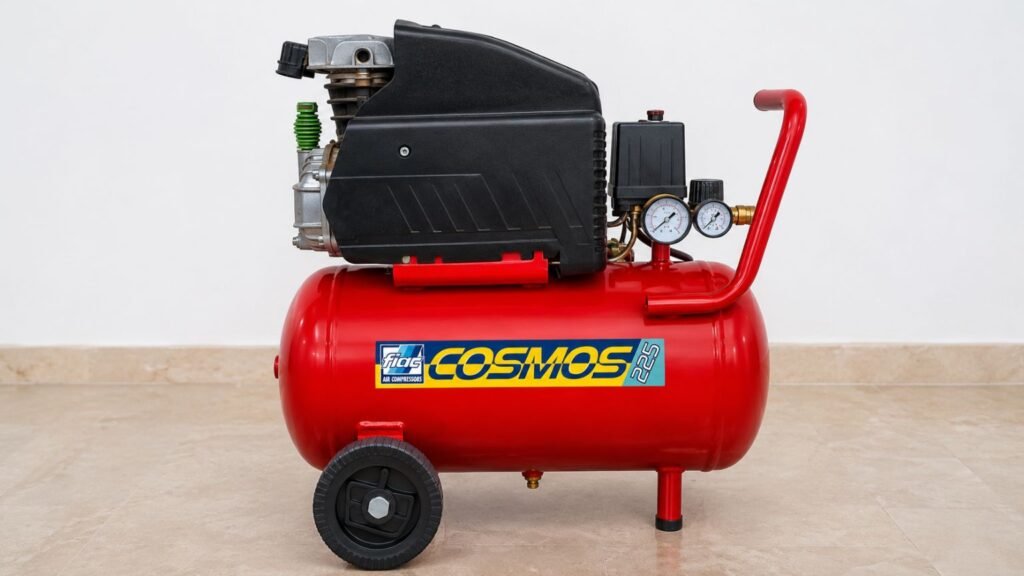
The FIAC COSMOS 225 air compressor is a compact, oil-lubricated piston compressor designed for DIY users and light workshop applications. Equipped with a 2 HP (1.5 kW) motor, a 24-litre air tank and a maximum pressure of 8 bar, it provides compressed air for everyday tasks such as inflation, cleaning and compatible pneumatic tools.
In this review, we examine its main specifications, design, practical applications, advantages and limitations. We also include a real-world reference: a friend of ours has used this model for several years. This is an example of long-term use, rather than a formal performance test.
FIAC COSMOS 225: Overview
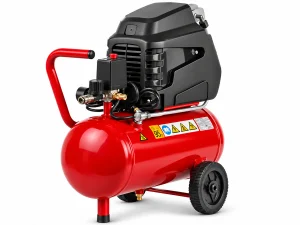
The FIAC COSMOS 225 is a portable, direct-driven compressor with an oil-lubricated piston pump. Its compact tank and wheeled design make it suitable for users who need compressed air without installing a large stationary compressor.
According to FIAC, the model is intended mainly for DIY applications. It includes a pressure regulator, two pressure gauges and a universal quick coupling, making it convenient to connect compatible air tools and accessories.
Its 2 HP motor and 24-litre tank offer a practical combination for occasional workshop jobs and general maintenance tasks.
FIAC COSMOS 225 Technical Specifications
| Specification | Details |
|---|---|
| Brand | FIAC |
| Model | COSMOS 225 |
| Product code | 1129102751 |
| Compressor type | Direct-driven piston compressor |
| Lubrication | Oil-lubricated |
| Motor power | 2 HP (1.5 kW) |
| Supply voltage | 230 V |
| Frequency | 50 Hz |
| Number of phases | Single-phase |
| Tank capacity | 24 litres |
| Maximum pressure | 8 bar (116 PSI) |
| Pump element | GM148 |
| Oil capacity | 0.22 litre |
| Pump speed | 2,850 rpm |
| Weight | 24 kg |
| Dimensions | 610 × 310 × 580 mm |
Airflow specification: FIAC lists an air displacement of 170 L/min (approximately 6 CFM) for the COSMOS 225. This figure refers to air displacement and should not be confused with Free Air Delivery (FAD), which represents the actual usable air delivered by the compressor. FAD is particularly important when checking whether a compressor can operate a specific pneumatic tool.
The FIAC COSMOS 225 air compressor should be selected based on the air requirements of your tools, not just its maximum pressure. Always check the required airflow before connecting a pneumatic tool.
For more detailed product information, visit the official FIAC COSMOS 225 product page.
Motor and Pump Design
The COSMOS 225 uses a 2 HP (1.5 kW) electric motor connected directly to its piston pump. This direct-drive arrangement avoids the belt and pulley system found on some larger compressors.
The pump is oil-lubricated, meaning that oil helps reduce friction between moving components during operation. This type of compressor requires regular oil-level checks and maintenance according to the manufacturer’s instructions.
FIAC identifies the pump element as the GM148, with a published pump speed of 2,850 rpm.
For anyone considering this model, the important point is that it is a compact compressor intended for relatively light applications rather than continuous, heavy-duty pneumatic work.
Tank Capacity and Working Pressure
The compressor has a 24-litre air receiver and a maximum pressure of 8 bar (116 PSI).
The tank stores compressed air and helps supply tools between pump cycles. However, a 24-litre tank does not mean that the compressor can deliver a high volume of air continuously. When a connected tool consumes air quickly, the pressure in the tank falls and the compressor must run again to replenish the supply.
The two pressure gauges allow users to monitor the tank pressure and the regulated outlet pressure, making it easier to check the compressor’s operating conditions.
Always follow the pressure requirements of the tool being used. The compressor’s maximum pressure should not be confused with the recommended operating pressure of every accessory.
Main Features of the FIAC COSMOS 225
1. Compact 24-Litre Tank
The 24-litre receiver provides a useful supply of stored air for short tasks. Its compact size also makes the compressor easier to accommodate in a small workshop or garage.
2. 2 HP Electric Motor
The 2 HP motor provides the power needed to operate the compressor pump. It runs on a 230 V, single-phase supply, which is commonly available in domestic and small-workshop electrical installations.
Before use, check that the electrical supply, plug, cable and circuit protection are suitable for the compressor.
3. Oil-Lubricated Pump
The oil-lubricated pump requires periodic maintenance, including checking the oil level and replacing the oil at the intervals specified by FIAC.
Users should use the lubricant grade recommended by the manufacturer rather than choosing an oil at random.
4. Pressure Regulator and Double Gauges
The pressure regulator helps adjust the outlet pressure for different applications. The two gauges allow the user to monitor the pressure information provided by the compressor.
This makes it easier to set the pressure appropriately before connecting and operating a pneumatic tool.
5. Universal Quick Coupling
The universal quick coupling makes connecting compatible air hoses and accessories more convenient. Before connecting a tool, check that its fitting is compatible with the compressor’s outlet.
6. Portable Design
With a 24-litre tank and a published weight of 24 kg, the COSMOS 225 is designed to be moved when necessary. Its handle and wheels help with positioning around a garage or workshop.
It is still important to move it carefully and avoid pulling it by the electrical cable or air hose.
What Can You Use the FIAC COSMOS 225 For?
The COSMOS 225 can support a range of everyday compressed-air tasks, provided the air consumption of the tool is within the compressor’s capabilities.
Tyre and Equipment Inflation
A suitable inflation gun can be used for car tyres, bicycle tyres, motorcycle tyres and other inflatable equipment. Always check the required pressure and use an accurate tyre-pressure gauge.
Cleaning with Compressed Air
A blow gun can help remove dust and loose debris from workshop equipment, work surfaces and suitable machinery.
Use compressed air carefully. Wear eye protection, avoid directing air towards people, and never use compressed air to clean skin or clothing.
Light Spray Painting
The compressor may be suitable for some small painting jobs when paired with a spray gun whose air consumption is compatible with the compressor.
Check the spray gun’s required airflow and working pressure before buying or connecting it. Larger spray guns and continuous painting work may require a compressor with a greater air-delivery capacity.
Pneumatic Nailers and Staplers
Some small pneumatic nailers and staplers can operate with a compressor of this size. However, compatibility depends on the tool’s air consumption, working pressure and firing frequency.
Check the manufacturer’s requirements for the specific nailer or stapler rather than assuming that every pneumatic tool will work with a 24-litre compressor.
Practical Limitations: What Should You Not Expect?
A compact compressor can be useful, but it is important to understand its limitations before purchasing one.
The 24-litre tank does not provide an unlimited supply of compressed air. Tools that consume a large amount of air continuously can cause the compressor to run frequently and struggle to maintain pressure.
For example, large impact wrenches, sandblasting equipment, demanding pneumatic grinders and continuous spray-painting applications may require a larger compressor with a higher Free Air Delivery (FAD).
If your work involves these applications, compare the tool’s required airflow with the compressor’s actual delivered airflow. A larger tank alone does not solve a shortage of air delivery.
Real-World Use: A Friend’s Experience
One useful point of reference for this review is that a friend of ours has used the FIAC COSMOS 225 for several years.
This gives us an example of the model being used in a real working environment rather than discussing it only from product specifications. However, we have not treated this as a formal performance test, and we are not attributing specific claims about reliability, noise or maintenance history to his experience.
For a buyer, this is a reminder that the condition of a used compressor, its maintenance history and the type of work it performs are all important considerations.
Maintenance Tips for the FIAC COSMOS 225
Regular maintenance helps keep an oil-lubricated compressor in good working condition. Always consult the manufacturer’s instructions for the correct maintenance intervals and procedures.
- Check the oil level: Inspect the pump oil level before use as instructed by FIAC. Do not operate the compressor with insufficient oil.
- Change the oil when required: Follow the recommended service interval and use the specified compressor oil.
- Drain the tank: Release accumulated moisture from the receiver using the drain valve, following the manufacturer’s safety procedure.
- Keep the air filter clean: Inspect the intake filter and clean or replace it when necessary.
- Check hoses and fittings: Look for leaks, cracks or damaged couplings before operating the compressor.
- Keep the compressor ventilated: Place it on a stable surface with enough space around the motor and pump for cooling.
- Inspect the electrical cable: Do not use the compressor if the cable, plug or electrical components are damaged.
Before carrying out maintenance, switch off and disconnect the compressor from the electrical supply. Release pressure safely where the procedure requires it. Never open or work on a pressurised air receiver.
Is the FIAC COSMOS 225 Worth Considering?
The FIAC COSMOS 225 air compressor is worth considering if you need a compact machine for inflation, cleaning and compatible small pneumatic tools.
Its main advantages are its 2 HP motor, 24-litre tank, 8-bar maximum pressure, oil-lubricated pump and practical accessories such as the regulator and double gauges.
Its main limitation is its relatively small air receiver and limited airflow compared with larger workshop compressors. It is not the right choice for every pneumatic tool, especially equipment that requires a high and continuous air supply.
Before buying, compare the compressor’s actual air delivery with the requirements of the tools you intend to use. This is more important than choosing a compressor based only on horsepower or maximum pressure.
If your workshop also includes woodworking equipment, you may find our DeWalt D27111 Combination Saw review useful. The saw is a separate electric workshop tool, not an air-powered accessory.
Frequently Asked Questions
Is the FIAC COSMOS 225 suitable for home use?
Yes. FIAC describes the COSMOS 225 as a model intended for DIY use. It can be useful for inflation, cleaning and other compatible light workshop applications.
How much air can the FIAC COSMOS 225 store?
Its air receiver has a capacity of 24 litres.
What is the maximum pressure?
The published maximum pressure is 8 bar (116 PSI).
Does the FIAC COSMOS 225 require oil?
Yes. It is an oil-lubricated compressor, so its pump oil level and replacement intervals need to be checked according to the manufacturer’s instructions.
Can it operate a spray gun?
It may operate some small spray guns, but compatibility depends on the spray gun’s air consumption and required working pressure. Check these specifications before use.
Is it suitable for continuous professional work?
It is better suited to DIY and light workshop applications. For demanding continuous work, a larger compressor with a higher air-delivery capacity is generally a better choice.
Final Verdict
The FIAC COSMOS 225 is a compact 2 HP air compressor designed for users who need a practical source of compressed air for everyday tasks. Its 24-litre tank, 8-bar maximum pressure, oil-lubricated pump and portable design make it a useful option for a small garage or workshop.
However, buyers should understand its airflow limitations and choose pneumatic tools carefully. For occasional tasks and compatible accessories, it can be a practical solution. For continuous, air-intensive applications, a larger compressor is the more appropriate choice.
If you are comparing different models before making a purchase, see our guide to Best Portable Air Compressors for Workshop and Construction Use for more options and buying advice.