Choosing the right welding machine can make metalworking, repairs, and fabrication projects easier. However, different welding machines are designed for different tasks. Some are suitable for general repairs, while others are better suited to detailed metalwork or repeated fabrication jobs.
In this guide, we explain the main types of welding machines, their advantages and limitations, and the features you should consider before choosing a welder for home, workshop, or professional use.
What Is a Welding Machine?
A welding machine is equipment used to join metal parts through heat, pressure, or a combination of both. Many common welding machines use an electric arc to generate the heat needed to form a joint.
Depending on the welding process, the machine may use a consumable electrode, continuously fed wire, or a non-consumable tungsten electrode. Different processes require different accessories, consumables, and operating techniques.
Welding machines are used in metal fabrication, construction, equipment maintenance, automotive repair, and many other applications. Choosing the right machine depends on the materials, their thickness, the working environment, and the type of weld required.
Common Types of Welding Machines
1. Stick Welding Machine (MMA)
Stick welding, also known as Manual Metal Arc (MMA) or Shielded Metal Arc Welding (SMAW), uses a flux-coated consumable electrode to create an electric arc and join metal parts.
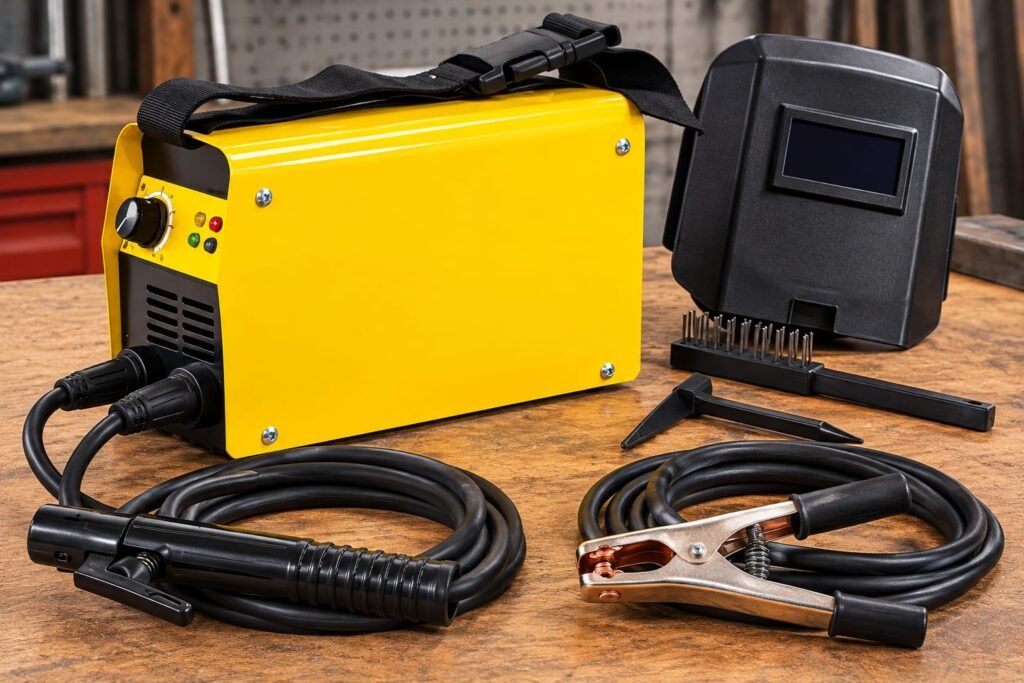
Many portable inverter welders are designed for stick welding. They are commonly used for general repairs, maintenance, and certain construction tasks.
Advantages:
- Relatively simple equipment setup.
- Does not require an external shielding-gas cylinder for standard stick welding.
- Suitable for many repair and maintenance applications.
- Available in compact and portable designs.
Limitations:
- Electrodes need to be replaced as they are consumed.
- Slag usually needs to be removed after welding.
- Producing consistent welds requires practice.
- Thin metal can be difficult to weld without burn-through.
A suitable MMA welder can be a practical choice for users who need a machine for general metal repairs.
2. MIG/MAG Welding Machine
MIG and MAG welding use a continuously fed wire electrode and shielding gas to protect the weld area from atmospheric contamination. MIG generally uses an inert gas, while MAG uses an active gas.
These machines are commonly used in metal fabrication, automotive work, and production environments where continuous wire feeding can improve productivity.
Advantages:
- Continuous wire feeding supports efficient welding.
- Can produce consistent welds with the correct setup and technique.
- Useful for a range of fabrication and repair tasks.
- Often convenient for repeated welding work.
Limitations:
- Many setups require a shielding-gas cylinder and regulator.
- Wire-feed and voltage settings must match the job.
- Wind can interfere with shielding gas.
- The equipment setup may be less portable than a basic stick welder.
Before buying a MIG/MAG machine, check which wire sizes, materials, and gas arrangements it supports.
3. TIG Welding Machine
Tungsten Inert Gas (TIG), also called Gas Tungsten Arc Welding (GTAW), uses a non-consumable tungsten electrode and shielding gas. Filler metal can be added separately when needed.
TIG welding is often chosen when precise control and a clean finish are important. It can be used for materials such as stainless steel and aluminum when the machine and setup are suitable.
Advantages:
- Offers precise control over the welding process.
- Can produce clean, high-quality welds with the right technique.
- Suitable for certain thin materials and detailed work.
- Supports different applications depending on machine capabilities.
Limitations:
- Requires practice and coordination.
- Can be slower than some wire-fed processes.
- Shielding gas and additional accessories are generally required.
- Aluminum welding may require a machine with suitable AC capability.
TIG equipment is worth considering when precision matters more than speed and the operator has the necessary skills.
4. Flux-Cored Welding Machine
Flux-Cored Arc Welding (FCAW) uses a tubular wire containing flux. Depending on the wire and process, shielding may come from the flux itself or from an additional shielding gas.
Some wire-feed machines support flux-cored wire as an alternative to solid MIG wire. However, compatibility depends on the machine design and manufacturer specifications.
Advantages:
- Some self-shielded flux-cored wires are useful for outdoor applications.
- Continuous wire feeding can support productive welding.
- Suitable for particular fabrication and repair tasks.
Limitations:
- Some processes produce slag that requires cleanup.
- Wire and machine compatibility must be checked.
- Fumes and spatter can be significant.
- Not every MIG machine supports every flux-cored wire.
Check whether a machine supports self-shielded flux-cored wire, gas-shielded flux-cored wire, or both.
5. Multi-Process Welding Machine
A multi-process welding machine is designed to support two or more welding processes in one unit. Depending on the model, it may combine MMA, MIG, flux-cored, or certain TIG functions.
These machines can be useful for users who need flexibility for different jobs but want to avoid purchasing separate machines for every process.
Before choosing one, confirm which processes are actually supported. Some models require additional torches, gas equipment, or accessories that may not be included in the package.
Important Features to Check Before Buying
Output Amperage
The available welding current affects the electrodes or wire that can be used and the material thickness a machine can handle under suitable conditions. Choose a current range that matches your usual work rather than relying on the maximum amperage alone.
Input Voltage and Power Supply
Check the machine’s required input voltage and whether it is compatible with your electrical supply. The circuit, wiring, protective devices, plug, and machine requirements must all be suitable.
Duty Cycle
Duty cycle indicates how long a machine can weld within a specified reference period at a stated output before it needs to cool down.
For example, a 20% duty cycle over a ten-minute reference period means approximately two minutes of welding and eight minutes of cooling under the stated test conditions. Always compare duty-cycle figures at the same output current.
Portability and Weight
A compact inverter welder can be convenient for maintenance work and moving between job sites. Consider its weight, cable length, output, cooling requirements, and the accessories needed for the welding process.
Material Compatibility
Not every welding machine is suitable for every metal. Confirm that the machine and process can handle the materials you plan to join, including mild steel, stainless steel, or aluminum.
Related Tool Guides
If you are preparing your workshop setup or working on job sites, you may also find these guides useful: