Introduction
A Bi-Metal Hole Saw Set is a practical addition to the toolbox of electricians, plumbers, carpenters, and other construction professionals. It allows users to cut clean, round holes in different materials without removing the entire centre of the material, as a conventional drill bit would.
Whether you need an opening for electrical cables, a pipe connection, a ventilation fitting, or another installation, a hole saw can make the job faster and more accurate when the correct size and cutting method are used.
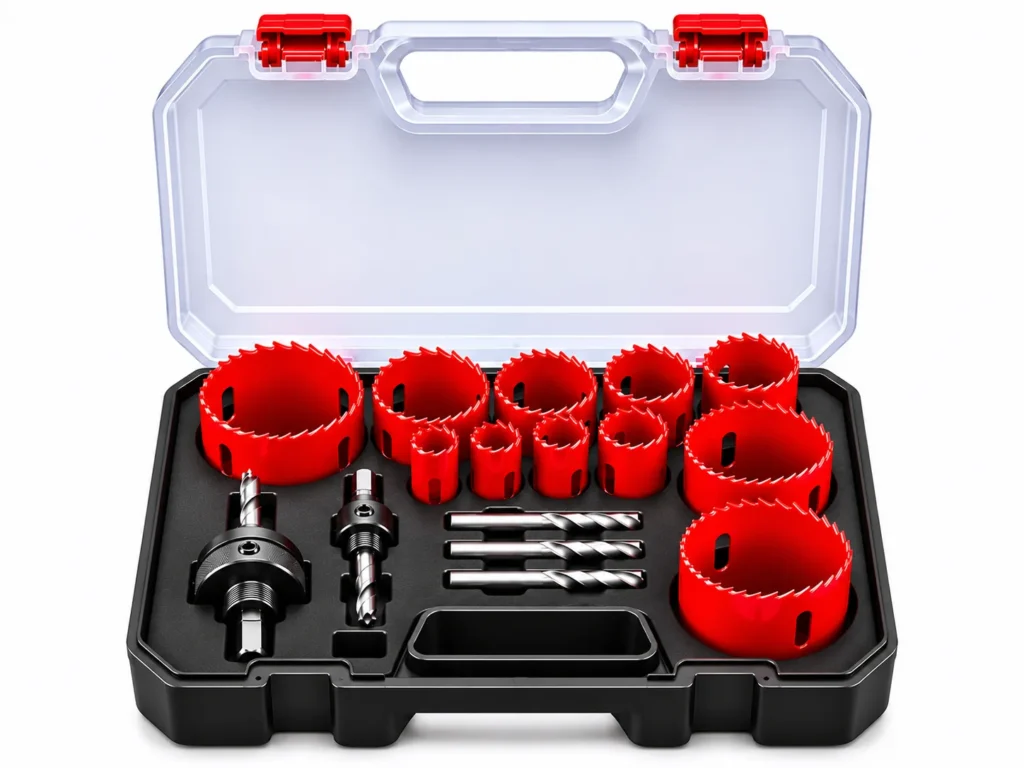
A typical Bi-Metal Hole Saw Set includes several hole saws in different diameters, one or more arbors, pilot drill bits, and a storage case. However, the number of pieces and included accessories can vary between sets.
This guide explains how these tools work, their main components, common applications, advantages, limitations, and what to consider before buying.
What Is a Bi-Metal Hole Saw Set?
A bi-metal hole saw is a cylindrical cutting tool with sharp teeth around its cutting edge. It is designed to cut a circular opening while leaving most of the material inside the circle intact.
The term bi-metal refers to its construction, which combines two types of steel. The cutting edge is made from high-speed steel (HSS), while the body uses a tougher steel that provides strength and flexibility.
This combination makes bi-metal hole saws suitable for a range of applications, including cutting certain metals, wood, and plastics.
Unlike a standard twist drill bit, which removes material across its full diameter, a hole saw cuts mainly around the circumference. This makes it useful when larger openings are required.
Main Components of a Bi-Metal Hole Saw Set
Understanding the components of a Bi-Metal Hole Saw Set helps users assemble the accessories correctly and get better results.
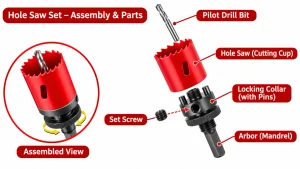
1. Bi-Metal Hole Saws
These are the cylindrical cutting cups with toothed edges. Each hole saw has a specific diameter, allowing users to select the size required for the installation.
The teeth perform the cutting, while the hollow centre retains the circular piece of material until it is removed.
2. Arbor or Mandrel
The arbor, also called a mandrel, connects the hole saw to the drill. It holds the saw securely and transfers the drill’s rotation to the cutting tool.
Different arbors may be required depending on the hole saw diameter and connection system. Always check compatibility before assembling the set.
3. Pilot Drill Bit
The pilot drill bit is fitted through the centre of the arbor. Its pointed cutting tip drills a small guide hole before the larger hole saw teeth begin cutting.
This helps keep the hole saw centred and reduces the chance of it moving across the work surface when starting a cut.
4. Locking Mechanism
Many arbors include a locking arrangement that secures the hole saw in position. Depending on the design, this may use threads, a locking collar, or other retaining components.
A properly secured connection helps prevent unwanted movement during operation.
5. Storage Case
The case keeps the different hole saw sizes and accessories organised. It also makes transportation and storage easier, especially for professionals who carry several tools between jobs.
Common Uses of a Bi-Metal Hole Saw Set
A Bi-Metal Hole Saw Set is useful for many installation and workshop tasks. Its versatility depends on the cutting material, the hole saw specification, and the manufacturer’s recommendations.
Electrical Installations
Electricians can use suitable hole saw sizes to create openings in metal enclosures, electrical panels, cable entry points, and certain wooden or plastic surfaces.
The correct diameter is important when preparing openings for cable glands, fittings, and other electrical accessories.
Always check the required opening size before cutting, and make sure the work area is isolated from electrical power.
Plumbing Work
Plumbers may use hole saws to create openings for pipes and fittings through suitable materials such as wood, plastic, and certain sheet metals.
Choosing the correct diameter helps provide enough clearance for the pipe or fitting without making the opening unnecessarily large.
Carpentry and Woodworking
Suitable hole saws can create circular openings in wood-based materials, panels, and other compatible surfaces.
They are useful for openings required by furniture fittings, cable routing, and some installation accessories.
Metalworking
Bi-metal hole saws are commonly used for cutting openings in suitable metal sheets, profiles, and other compatible metal components.
When cutting metal, use an appropriate low speed, maintain steady pressure, and apply suitable cutting lubricant when recommended.
Important: A standard bi-metal hole saw is not designed for every material. Ceramic tiles, porcelain, glass, brick, and concrete generally require specialised hole saws designed for those surfaces.
Key Features to Consider
When evaluating a Bi-Metal Hole Saw Set, consider the following features rather than choosing a kit based only on the number of pieces.
Range of Hole Diameters
A useful set should include diameters that match the openings you regularly need to make.
Smaller sizes are useful for cable entries and fittings, while larger sizes may be required for pipes, ventilation components, and other installations.
Before buying, compare the included diameters with the sizes used in your work.
Cutting Edge Quality
The quality of the HSS cutting teeth has a direct effect on cutting performance and service life.
Look for clearly stated material specifications and a well-finished cutting edge. Some products use cobalt-containing HSS, but the exact material grade should be confirmed from the manufacturer’s information.
Arbor Compatibility
Check whether the set includes the required arbor or mandrel and whether it fits your drill.
Also check whether the arbor supports all the hole saw sizes included in the kit. Some sets use different arbors for different diameter ranges.
Pilot Drill Design
A sharp, correctly fitted pilot drill helps guide the hole saw during the initial stage of cutting.
It is also worth checking whether replacement pilot bits are available, since they can wear or become damaged with repeated use.
Cutting Depth
Hole saws have a limited cutting depth determined by the height of the cutting cup.
If you regularly work with thicker materials, check the cutting depth before choosing a set. Some jobs may require cutting from both sides or using a different cutting method.
Storage and Organisation
A strong case with clearly arranged spaces makes it easier to identify the correct size and keep the accessories together.
For professionals who transport tools frequently, the quality of the case and its locking clips is also worth considering.
Advantages and Limitations
A Bi-Metal Hole Saw Set offers several practical benefits, but it is important to understand its limitations.
Advantages
- Multiple hole sizes: One set can cover several common installation requirements.
- Versatile applications: Suitable models can cut certain metals, wood, and plastics.
- Efficient cutting: The circular cutting design removes less material than drilling a full-diameter hole.
- Reusable accessories: With correct use and maintenance, hole saws can be used for many cutting operations.
- Organised storage: A dedicated case keeps the accessories together and easy to transport.
Limitations
- Material restrictions: Standard bi-metal hole saws are not suitable for every hard or abrasive material.
- Heat generation: Excessive speed or pressure can overheat the cutting teeth and reduce their service life.
- Limited cutting depth: The depth of the cup can restrict the thickness of material that can be cut in one operation.
- Accessory compatibility: Not every arbor fits every hole saw or drill.
- Material plugs: The circular cut-out can become stuck inside the hole saw and may need to be removed carefully.
How to Use a Bi-Metal Hole Saw Set Correctly
Using a hole saw correctly helps improve accuracy and reduce unnecessary wear.
- Choose the correct diameter: Select a hole saw that matches the required opening.
- Check the material: Confirm that a bi-metal hole saw is suitable for the surface you intend to cut.
- Assemble the arbor: Fit the appropriate arbor and pilot drill, then secure the hole saw according to its design.
- Mark the centre: Measure and mark the exact location of the opening.
- Secure the workpiece: Clamp the material firmly whenever possible.
- Start at a controlled speed: Keep the pilot drill centred and allow the teeth to begin cutting without forcing the tool.
- Maintain steady pressure: Avoid pushing too hard. Let the cutting teeth do the work.
- Remove the material plug: Switch off and disconnect the drill before removing the cut-out piece or adjusting the accessories.
Practical Tips for Better Results
The following tips can help extend the life of your Bi-Metal Hole Saw Set and improve the quality of your work.
- Use the correct speed: Larger hole saws generally require lower speeds. Follow the manufacturer’s recommended RPM for the diameter and material.
- Avoid excessive pressure: Heavy pressure can damage the teeth and cause overheating.
- Use cutting lubricant on metal: Apply a suitable cutting fluid when recommended, especially when working with steel.
- Keep the hole saw straight: Tilting the drill during cutting can produce an uneven opening and put additional stress on the arbor.
- Clear metal chips regularly: Stop the drill before removing accumulated chips from the cutting area.
- Check the pilot drill: A damaged or blunt pilot bit can make accurate starting difficult.
- Clean and store the set: Remove debris after use and return each component to its correct place in the case.
How to Choose the Right Bi-Metal Hole Saw Set
Choosing the right Bi-Metal Hole Saw Set depends mainly on the type of work you perform.
For electricians, a useful range of smaller and medium diameters may be more important than having many very large hole saws.
Plumbers may need a wider selection of diameters for different pipe and fitting installations.
For general workshop use, a set with a balanced range of sizes, compatible arbors, replaceable pilot drills, and a durable case can be a practical option.
Before purchasing, consider these questions:
- Does the set include the diameters you actually use?
- Are the hole saws suitable for your working materials?
- Are the arbor and pilot drill included?
- Can the pilot drill be replaced?
- Is the cutting depth sufficient for your applications?
- Are replacement hole saws and accessories available?
A larger set is not automatically a better choice. It is usually more useful to buy a well-made kit that matches your regular work.
Frequently Asked Questions
What is a bi-metal hole saw used for?
A bi-metal hole saw is used to cut circular openings in compatible materials, including certain metals, wood, and plastics. It is commonly used in electrical installations, plumbing, carpentry, and general construction work.
Can a bi-metal hole saw cut stainless steel?
Some bi-metal hole saws are suitable for stainless steel, but cutting performance depends on the saw specification and the material thickness. Use the manufacturer’s recommended speed and cutting lubricant, and avoid excessive pressure.
Can I use a bi-metal hole saw on ceramic tiles?
No. A standard bi-metal hole saw is not designed for ceramic tiles or porcelain. Use a suitable diamond or tile-specific hole saw instead.
What is the purpose of the pilot drill bit?
The pilot drill creates a small guide hole at the centre of the opening. It helps position the hole saw accurately and reduces movement when starting the cut.
Do all hole saws fit the same arbor?
No. Compatibility depends on the hole saw’s connection system and diameter. Check the manufacturer’s specifications before combining accessories from different sets.
How can I make my hole saw last longer?
Use the correct cutting speed, avoid excessive pressure, apply suitable lubricant when cutting metal, keep the teeth clean, and store the accessories properly after use.
Final Verdict
A Bi-Metal Hole Saw Set is a useful and versatile tool kit for professionals and DIY users who regularly need to create circular openings in compatible materials.
Its value depends on the quality of the cutting teeth, the range of available diameters, arbor compatibility, and the accessories included in the case.
Rather than choosing a set simply because it contains more pieces, focus on the sizes and materials that match your actual work. With the right selection and proper use, a good hole saw set can become a dependable part of a professional toolbox.
Related Tools and Guides
Best Professional Cordless Screwdriver Review: Features, Uses and Buying Guide.
Diamond Hole Saw Drill Bit Set: Features, Uses, and Buying Tips.
Further Technical Information
For more technical information about bi-metal hole saw construction, cutting teeth, compatible materials, and applications, see the RUKO Guide to Bi-Metal Hole Saws and Their Applications.