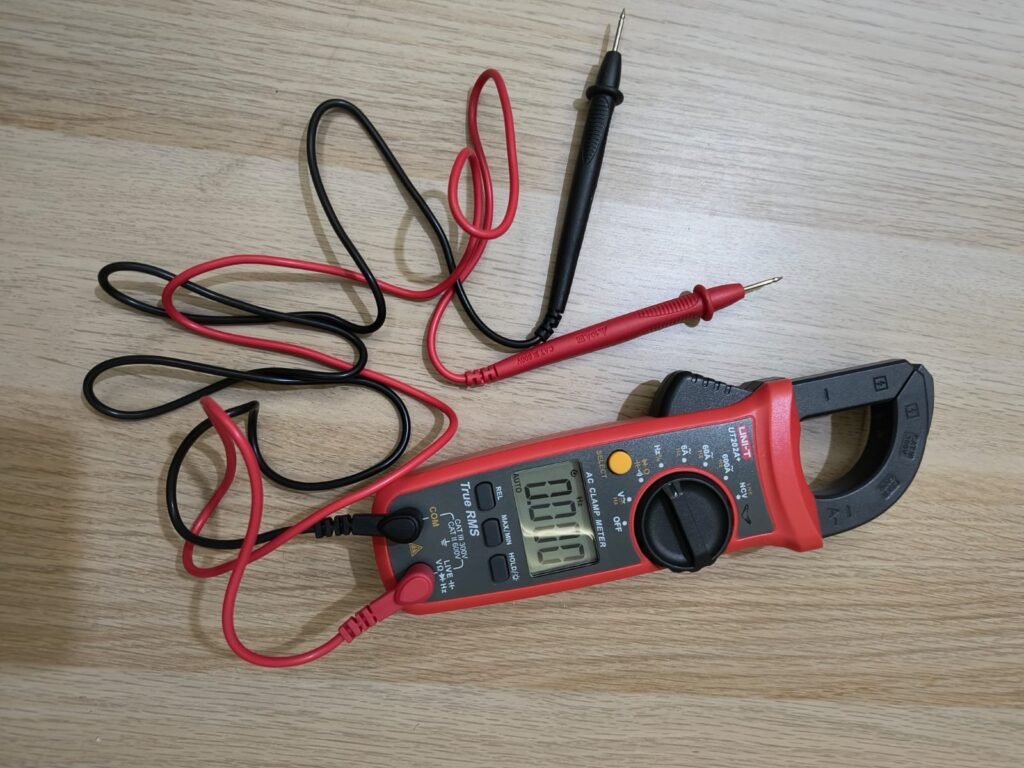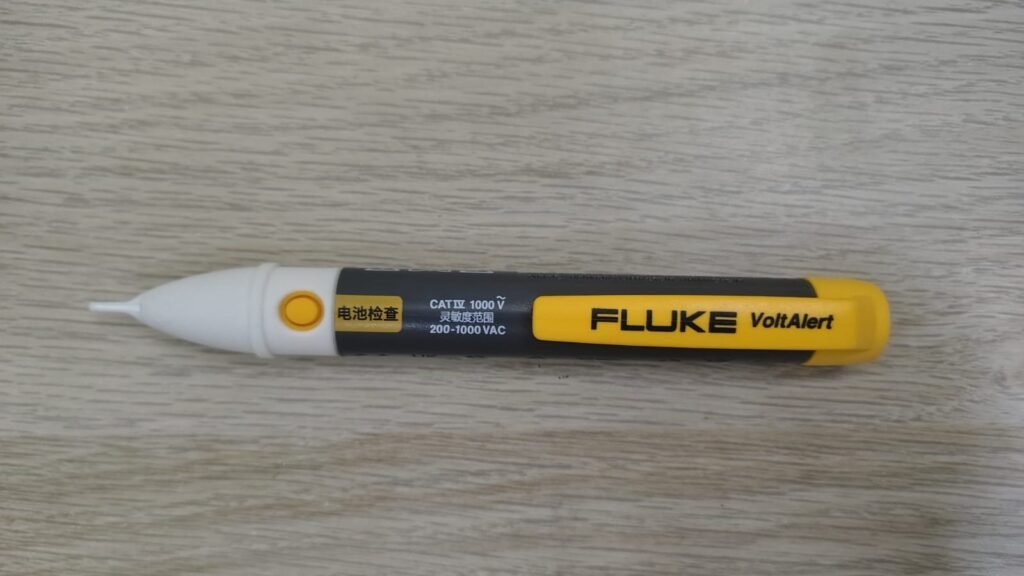
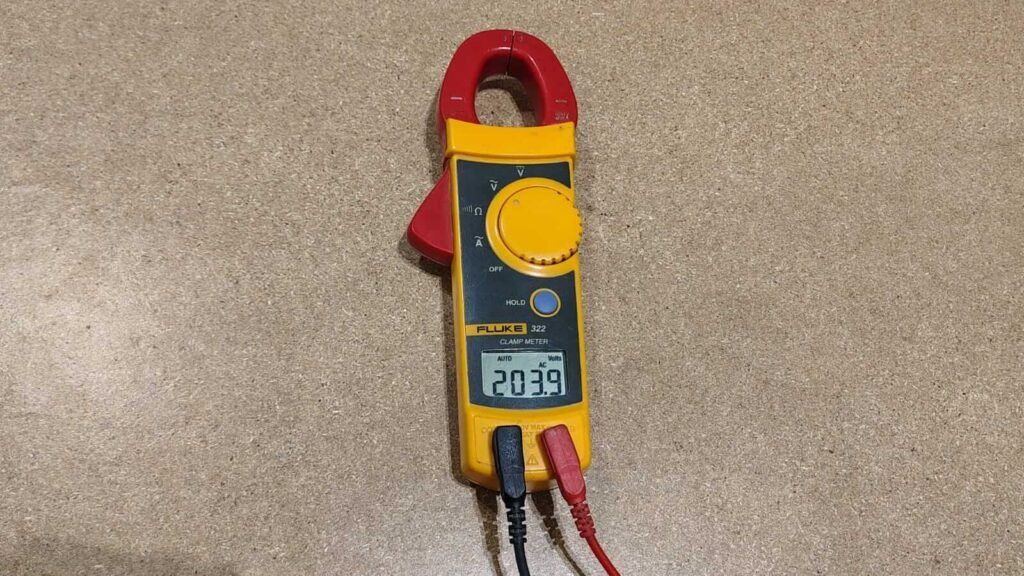
This Fluke 322 Clamp Meter Review covers my experience with the meter, its main features and limitations, and how it compares with selected alternatives for electricians.
My Experience with the Fluke 322 Clamp Meter
I have worked as an electrician for 28 years, and I bought my Fluke 322 around 2010. It still works well today.
Sometimes I lend it to the workers on my team, and I always tell them the same thing: “You can lose any other tool, but not this one—this meter is very dear to me.” It is a practical tool that has earned its place in my toolbox.
Of course, one meter lasting this long does not guarantee the same lifespan for every unit. Care, storage, and working conditions all matter. Still, my experience is one reason I regard the Fluke 322 as a dependable tool for the tasks it is designed to handle.
What the Fluke 322 Measures
Fluke’s official 321/322 product page lists AC current up to 400 A, AC voltage up to 600 V, resistance up to 400 Ω, and continuity testing. The jaw opening is 25 mm (1 inch), which can be useful when working in relatively tight cable compartments.
Fluke’s technical datasheet also lists DC voltage measurement up to 600 V. The 322 uses an averaging AC response, not True-RMS.
For ordinary sinusoidal AC measurements within its ratings, an averaging meter may be suitable. On distorted or non-sinusoidal waveforms, readings may be less accurate than those from a suitable True-RMS instrument. If your work regularly involves variable-speed drives or electronic loads, consider whether a True-RMS meter is more appropriate.
Strengths:
- Straightforward operation.
- A compact jaw for everyday electrical work.
- Basic functions useful for many routine electrical checks.
Limitations:
- It is not a True-RMS meter.
- It does not provide some additional diagnostic functions found on newer models, such as clamp measurement of DC current, capacitance, frequency, or temperature.
Fluke 322 vs. Selected Alternatives
The best choice depends on the measurements you need. This table is a quick guide; confirm the exact model’s specifications, safety rating, and availability before buying.
Quick Comparison
| Model | Clamp current | True-RMS AC | Other functions |
|---|---|---|---|
| Fluke 322 | AC, up to 400 A | No | AC/DC voltage, resistance, continuity |
| Fluke 301 series | Varies by version | Varies by version | Functions vary by exact model |
| Fluke 323 | AC, up to 400 A | Yes | AC/DC voltage, resistance, continuity |
| Fluke 324 | AC, up to 400 A | Yes | Capacitance, contact temperature, backlight |
| Fluke 325 | AC and DC, up to 400 A | Yes | Capacitance, frequency, contact temperature, backlight, Min/Max |
Fluke 301 Series: Compact and Portable
The Fluke 301 family is designed around a slim, portable form. Available functions vary by exact model, so do not assume every 301 version has the same measurement capabilities. Check the full model number and official datasheet before purchasing.
Best for: Electricians who prioritize a compact design and have confirmed that the specific version covers their needs.
Fluke 323: True-RMS for General Troubleshooting
The Fluke 323 measures AC current up to 400 A, AC and DC voltage up to 600 V, resistance, and continuity. It provides True-RMS AC measurements, which can be useful when measuring suitable non-sinusoidal signals. It does not measure DC current through the clamp.
Best for: Routine troubleshooting where True-RMS AC measurements and AC/DC voltage checks are useful.
Fluke 324: Adds Capacitance and Temperature
The Fluke 324 measures AC current up to 400 A and AC/DC voltage up to 600 V. It also adds capacitance, contact-temperature measurement, and a backlit display. Fluke lists this model as discontinued or reclassified and suggests the 325 as an alternative, so availability may be limited. If you find one for sale, verify its condition, authenticity, warranty, and price before buying.
Best for: Buyers who specifically need capacitance and contact-temperature measurement and can verify the unit’s condition and support.
Fluke 325: More Diagnostic Functions
The Fluke 325 measures AC and DC current through the clamp up to 400 A, AC and DC voltage up to 600 V, resistance, continuity, capacitance, frequency, and contact temperature. It also includes a backlit display and Min/Max readings.
Best for: Maintenance work that benefits from DC current measurement and additional diagnostic functions.
Which Fluke Clamp Meter Should You Choose?
Choose based on the work you actually do, rather than the number of functions alone:
- Fluke 322: A straightforward option for AC current, AC/DC voltage, resistance, and continuity when its averaging AC response suits the job.
- Fluke 301 series: Consider it if a slim design is important, but check the exact version.
- Fluke 323: Consider it for True-RMS AC measurements and AC/DC voltage checks.
- Fluke 324: Offers capacitance and contact-temperature measurement, but confirm availability and condition.
- Fluke 325: Offers the broadest set of diagnostic functions in this comparison, including clamp measurement of DC current.
Before buying, compare specifications, CAT safety ratings, warranty, accessories, and price. An online listing does not necessarily mean a model is available new from an authorized seller in your country.
For more guidance on choosing electrical testing equipment, read my guide to Best Voltage Testers for Home Electrical Work in 2026.
Clamp Meter vs. Non-Contact Voltage Tester
A clamp meter and a non-contact voltage tester serve different purposes. A clamp meter measures current through its clamp and can measure voltage with its test leads. A non-contact voltage tester, such as the Fluke 2AC VoltAlert, provides a preliminary indication of AC voltage near a conductor; it does not replace a properly rated instrument for verifying that a circuit is de-energized.
Never rely on a non-contact tester alone to prove that a circuit is safe. Follow the correct isolation procedure and verify the absence of voltage with a suitable, properly rated tester. For more information, read my Fluke 2AC VoltAlert Review: Features and Safe Use.
Important Electrical Safety Considerations
- Check the meter’s measurement limits and CAT rating before use, and make sure they suit the electrical environment.
- Inspect the meter, clamp jaws, test leads, and probes for damage before testing.
- Follow the manufacturer’s instructions and use appropriate protective equipment.
- To measure current, clamp around one conductor only. Clamping around both live and neutral conductors together can cause their magnetic fields to cancel and produce an incorrect reading.
- Measure resistance and continuity only on a de-energized circuit after confirming it is safe to test.
- Never exceed the meter’s rated limits.
Final Verdict
The Fluke 322 is a practical, easy-to-use clamp meter for basic electrical checks. My own unit has served me well for more than fifteen years, although one person’s experience cannot guarantee the lifespan of every meter. Its main limitation is that it is not a True-RMS instrument, and it lacks some advanced functions found on newer models.
If you need True-RMS measurements, clamp measurement of DC current, or functions such as capacitance and temperature, compare the Fluke 323, 324, and 325. If your needs are more basic, the Fluke 322 may still be a useful option—provided its specifications and safety rating match the job.
Whichever model you choose, buy from a reputable seller and check the manufacturer’s documentation before use.